Urticaria (Hives)
High-YieldFree study guide for medical students and educators
Pruritic, circumscribed wheals (hives) due to transient dermal edema from mast cell histamine release. Lesions are raised with blanching centers and typically resolve within 24 hours without scarring.
- Very common (∼20% lifetime incidence) and usually benign, but can herald life-threatening anaphylaxis if severe. High-yield for exams as a prototype allergic reaction and urgent management scenario.
- Intensely itchy, red or skin-colored wheals with pale centers; individual lesions appear and fade within hours.
- Acute urticaria (<6 weeks): often provoked by an allergen (foods, drugs, insect stings) or infection. Chronic urticaria (≥6 weeks): usually idiopathic (80–90% of cases), often with an autoimmune basis (IgE or IgE receptor autoantibodies).
- Inducible (physical) subtypes: specific triggers cause hives – e.g., dermatographism (stroking skin), cold urticaria, cholinergic urticaria (exercise/heat), delayed pressure urticaria.
- Angioedema (deeper swelling of lips, eyelids, etc.) accompanies ~40% of cases, especially in severe episodes. Isolated angioedema without hives suggests a different mechanism (e.g., ACE inhibitor, C1 esterase inhibitor deficiency).
- Children often get acute hives after viral infections; chronic spontaneous urticaria is more common in adults (especially middle-aged women).
- Always assess for anaphylaxis in a patient with urticaria (airway, breathing, circulation) – if present, administer IM epinephrine immediately.
- Remove or avoid identifiable triggers (new medications, foods, cold exposure, etc.) and treat any underlying cause (e.g., infection).
- Extensive lab workup is usually not necessary. For chronic cases, consider targeted tests (e.g., TSH for autoimmune thyroid disease) based on history.
- If individual lesions persist >24–48 hours or heal with bruising, suspect urticarial vasculitis (requires further evaluation/biopsy).
| Condition | Distinguishing Feature |
|---|---|
| urticarial-vasculitis | painful urticarial lesions lasting >24 hours with residual purpura/bruising |
| hereditary-angioedema | recurrent angioedema without urticaria; C1 esterase inhibitor deficiency (bradykinin-mediated) |
- Avoid precipitating factors (allergens, NSAIDs, extreme temperatures, stress).
- First-line: daily non-sedating H1 blockers (2nd-generation antihistamines like cetirizine, loratadine). If needed, ↑ dose up to 2–4× standard or add H2 blocker (ranitidine) or leukotriene modifier (montelukast).
- For severe flares, a short course of oral corticosteroids can be used. Any signs of anaphylaxis (airway compromise, hypotension) → IM epinephrine immediately.
- Refractory chronic urticaria: consider omalizumab (anti-IgE mAb) which is highly effective. Immunosuppressants like cyclosporine are alternative options in specialist care.
- Remember the 6×6 rule: <6 weeks = acute (likely external trigger), ≥6 weeks = chronic (usually idiopathic).
- Each wheal lasts <1 day; if 'hives' persist in one spot >24 hours and leave a stain, think urticarial vasculitis instead.
- Angioedema involving the tongue or larynx, respiratory distress, or hypotension with hives → indicates anaphylaxis; administer epinephrine without delay.
- Check ABCs: if anaphylaxis present (hypotension, stridor/bronchospasm) → epinephrine IM + airway management.
- If only urticaria: give oral H1 antihistamine (non-sedating) and remove suspected triggers; observe response.
- Determine acute vs chronic (6-week cutoff). For chronic cases, perform focused workup (e.g., thyroid antibodies, infection screen) based on clinical suspicion.
- Escalate therapy as needed: increase antihistamine dose or add adjunct (H2 blocker, montelukast); if refractory, refer for omalizumab or cyclosporine.
- Child recovering from a viral infection develops transient widespread hives (wheals) but is otherwise well → acute urticaria from infection.
- Middle-aged woman with daily hives for 2+ months and occasional lip swelling; +anti-thyroid (TPO) antibodies → chronic autoimmune urticaria (associated with Hashimoto thyroiditis).
- After a peanut exposure, patient gets hives, throat tightness, and hypotension → anaphylaxis (IgE-mediated systemic reaction; requires epinephrine).
A 8-year-old boy develops a generalized, itchy, raised rash (see image) after recovering from a viral URI. The rash consists of transient blanching wheals that resolve within hours. He is otherwise well with normal vital signs.
A 45-year-old woman has had near-daily hives for the past 3 months with no identifiable trigger. She often develops large itchy wheals in the evenings, sometimes accompanied by swelling of her lips or eyelids. Lab tests are unremarkable except positive anti-thyroid peroxidase antibodies.
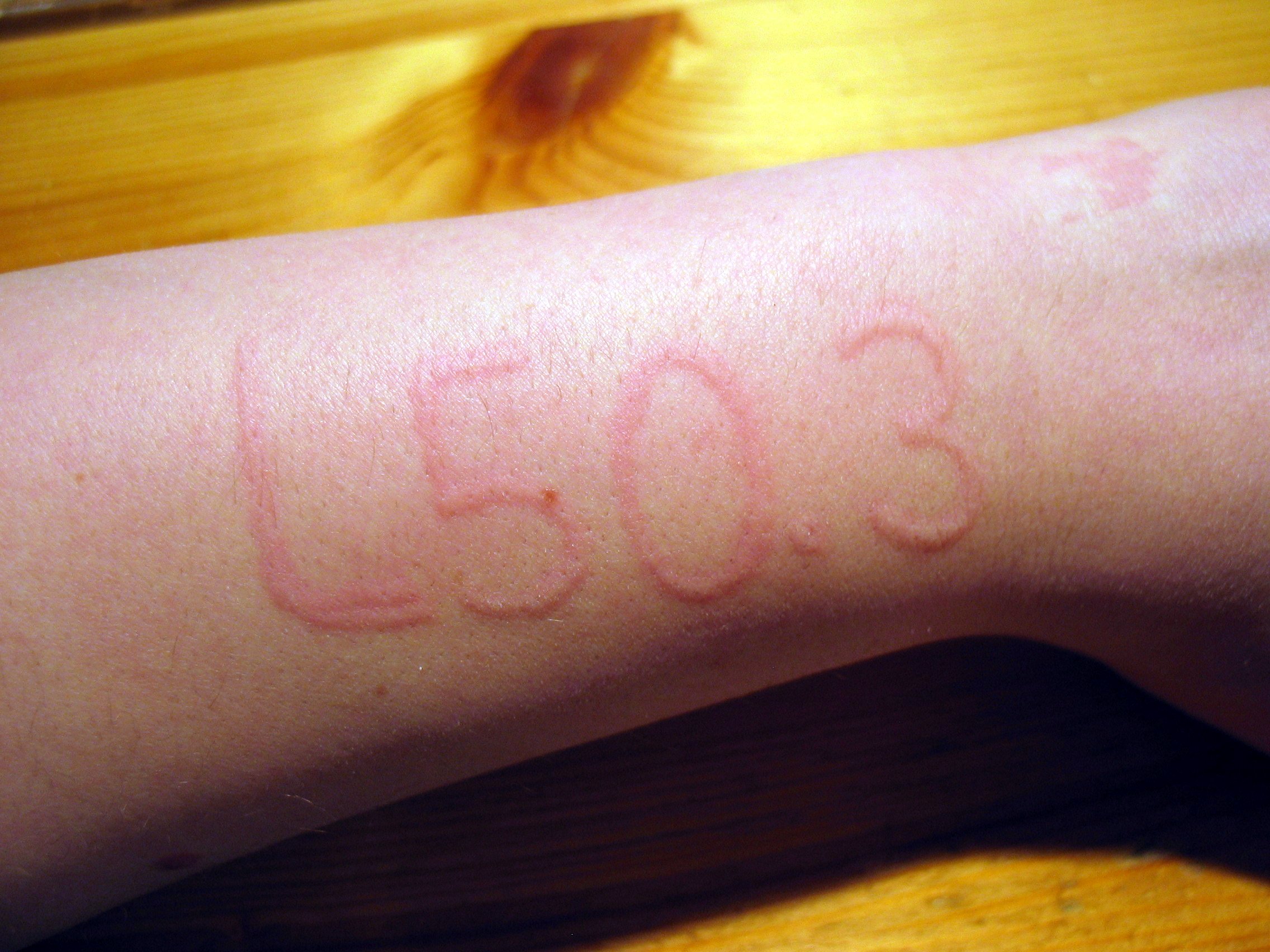
Dermatographic urticaria: "skin writing" causing raised wheals forming the letters 'L50.3' on the skin
image credit⚡At a Glance
High-Yield🔗Knowledge Map
Related Conditions
Differential Diagnoses
📚 References & Sources
- 1Hives (urticaria) – Wikipedia
- 2Schaefer, P. "Acute and Chronic Urticaria: Evaluation and Treatment." AAFP 95(11):717-724 (2017)
- 3Mehta S, et al. "Chronic Urticaria." StatPearls [Internet]. (Updated Dec 2025)
- 4Zuberbier T, et al. "The international guideline for the definition, classification, diagnosis, and management of urticaria." Allergy. 2022;77(3):734-766.
